

Gaps
When your assistant can't answer something well, that question comes back to you as work to do. Voyse groups the same question however differently it was phrased, counts how many people asked, and puts it in a queue called gaps. Working that queue is the highest-value half hour in this product: you are writing answers you know real candidates want, in the order they want them.
Open Knowledge Base in the sidebar and select the Gaps tab, or use Open gaps queue from your home screen.
Reading the queue
The Open tab holds gaps still to deal with; Resolved holds everything you've closed. Sort by Most mentioned to work by volume, or Most recent to see what's come up lately.
Each row shows the topic, how many candidates asked, and how recently — plus a label:
- New — first asked in the last week.
- Possibly stale — you have an answer, but it may be out of date.
- Anything else just reads Open.
Select a row to open it in place and see the actual question, in the candidate's own words — with anything that would identify the person asking, or that touches something sensitive, left out rather than quoted.
Answering one
Select the row's title to open it. What you see next depends on whether anything already comes close:
Nothing does. A box opens ready for your answer. Write it and select Approve. Voyse checks what you wrote before it goes live:
- If it doesn't say enough to answer the question, you're told so and can add more before trying again.
- If it contradicts an entry you already have, the row shows both side by side — Now and Proposed — with Keep what we have or Use the new version to settle it.
Once it's accepted, the row's label flips to Verified and the gap drops off the queue on its own. Nothing to come back and tick.
Something does. The row shows the entry it thinks is closest, with a quote from it. The lead action is Review the entry — take that route first, since updating what you have beats adding a duplicate. If you'd rather answer fresh instead, Write a different answer opens the same box described above.
Either way, every row also offers:
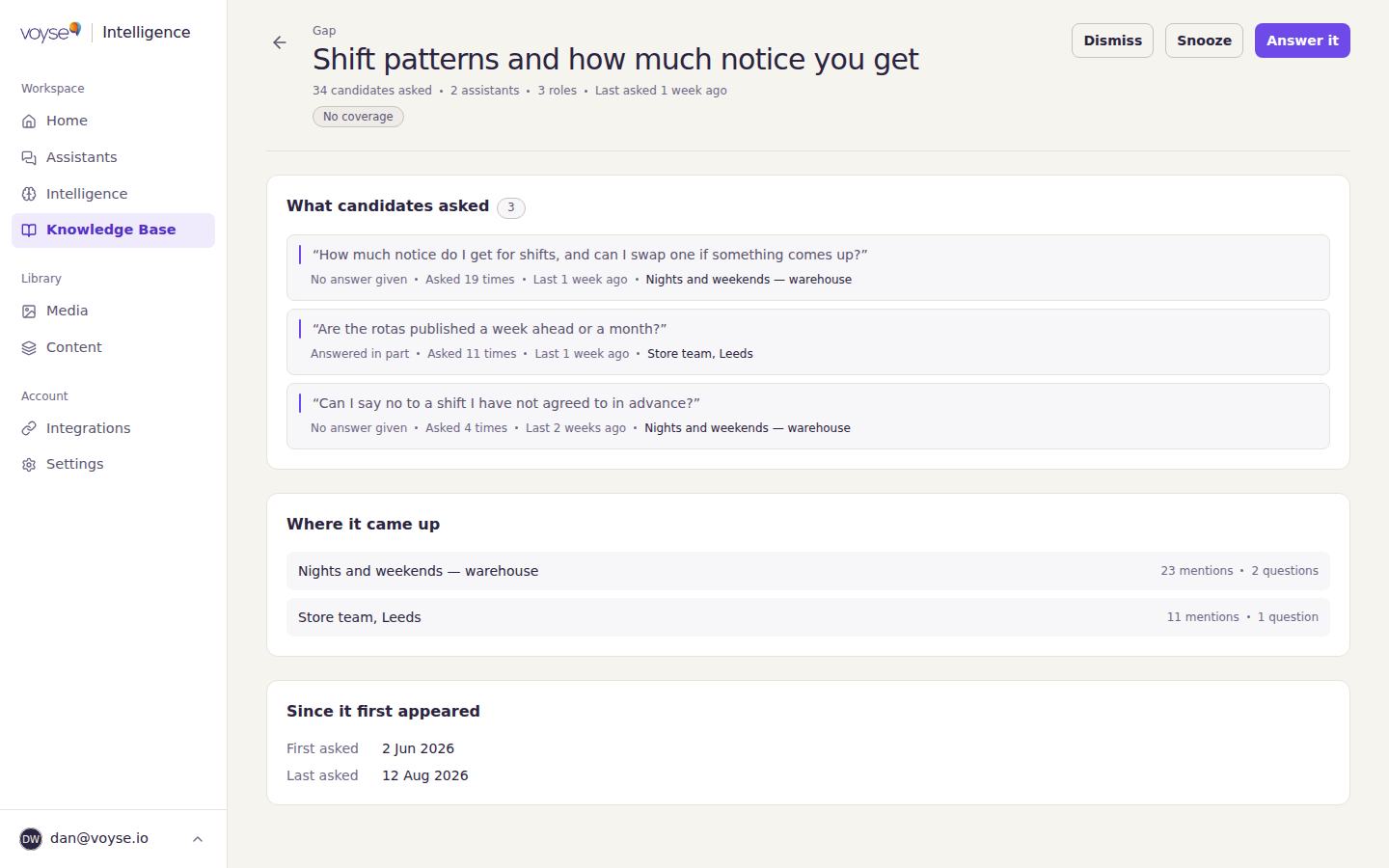
- Details — the whole picture: labelled plainly as No coverage or Possibly stale, with the entries that come closest (if any), every phrasing candidates used, which roles and assistants it came up in, and when it first and last appeared.
- Add from a file or URL — for a longer answer, this takes you to the add-knowledge screen instead, with the gap shown at the top. Paste or upload a document, select Read it, then accept what comes out on the review screen — see Build your knowledge base for what happens there.
When it isn't a gap
Not every gap needs an answer, and pretending otherwise fills your knowledge base with noise.
- Dismiss it when it isn't something you'll ever answer. Choose a reason — Not a real gap, Not something we answer, Already covered by another gap, or Another reason, where you say why. That note is for whoever finds this next, so write it for them.
- Snooze it when the answer isn't ready yet — a policy under review, a location not open. Choose 7 days, 30 days or 90 days and it comes back to the queue then.
Both are reversible: dismissed and snoozed gaps sit in Resolved, and Reopen puts one back.
What good looks like
An empty Open tab reads No gaps to show, and your home screen says All candidate questions are covered — great work. That state doesn't last — new questions arrive as new candidates do, which is the point of the queue rather than a failure of it. Most teams work it weekly.